

Artificial Intelligence is rapidly transforming industries, businesses, education, healthcare, and daily life. As AI adoption grows, two important concepts are becoming increasingly critical:
🛡️ AI Safety
and
🔐 AI Security
Although these terms are often used interchangeably, they address very different challenges.
Understanding the difference between AI Safety and AI Security is essential for developers, startups, enterprises, students, and policymakers building responsible AI systems.
🛡️ What is AI Safety?
AI Safety focuses on ensuring that AI systems behave safely, ethically, reliably, and in alignment with human values.
👉 The goal of AI Safety is to prevent harm caused by AI systems.
⚠️ AI Safety Concerns
- 🎭 Bias and unfair decisions
- 🧠 Hallucinations and misinformation
- 🚫 Unsafe recommendations
- 🔍 Lack of transparency
- ⚡ Misalignment with human intentions
- 🤖 Harmful autonomous behavior
✅ Examples of AI Safety
- Preventing chatbots from generating dangerous content
- Ensuring self-driving cars make safe decisions
- Reducing bias in hiring systems
- Keeping humans in control of AI actions
🧩 Common AI Safety Techniques
- 👨💻 Human oversight
- 🛑 AI guardrails
- 📖 Explainable AI (XAI)
- 🎯 AI alignment techniques
- 🧪 RLHF (Reinforcement Learning with Human Feedback)
- ⚖️ Ethical AI frameworks
🔐 What is AI Security?
AI Security focuses on protecting AI systems from cyberattacks, misuse, manipulation, and unauthorized access.
👉 The goal of AI Security is to prevent harm caused to AI systems.
⚠️ AI Security Threats
- 💉 Prompt injection attacks
- 🔓 AI jailbreaks
- 🕵️ Model theft
- ☣️ Data poisoning
- 🎯 Adversarial attacks
- 🌐 API abuse
- 📂 Training data leakage
✅ Examples of AI Security
- Protecting AI chatbots from prompt injection
- Preventing AI model theft
- Securing AI APIs and infrastructure
- Detecting malicious jailbreak attempts
🧩 Common AI Security Techniques
- 🔑 Authentication & access control
- 🔒 Encryption
- 🛡️ Security monitoring
- 🧪 Red teaming
- 🕵️ Threat detection
- ⚙️ Secure infrastructure
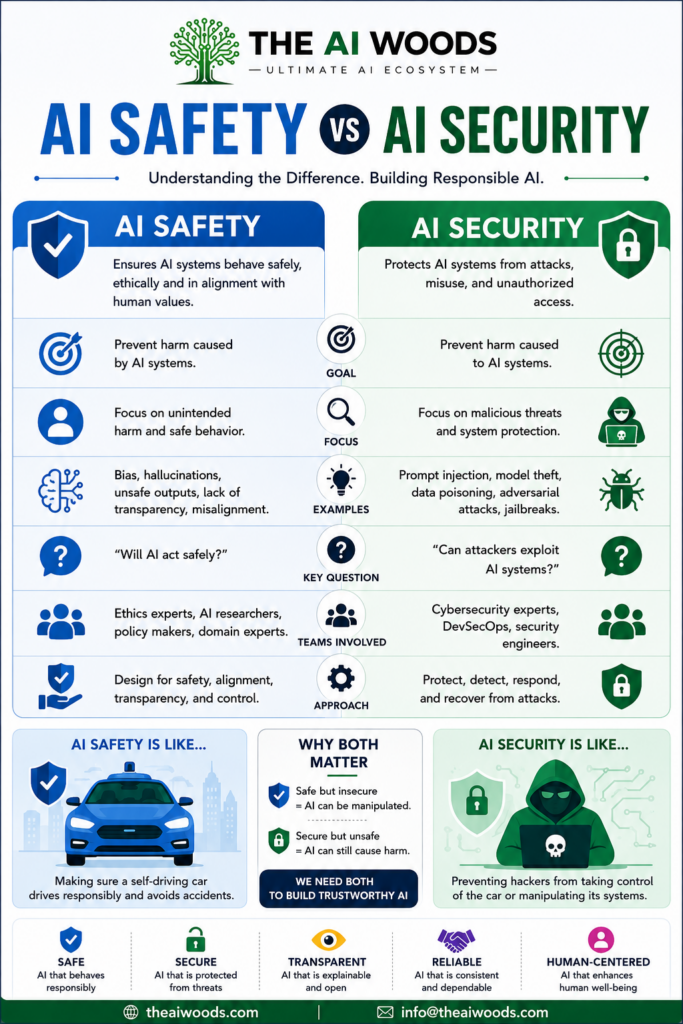
⚔️ AI Safety vs AI Security
| Aspect | 🛡️ AI Safety | 🔐 AI Security |
|---|---|---|
| Main Goal | Ensure AI behaves safely | Protect AI from attacks |
| Focus | Harm caused by AI | Harm caused to AI |
| Concern Type | Unintentional harm | Malicious threats |
| Examples | Bias, hallucinations | Prompt injection, model theft |
| Teams Involved | Ethics & AI researchers | Cybersecurity & DevSecOps |
| Key Question | “Will AI act safely?” | “Can attackers exploit AI?” |
🚗 Simple Real-World Analogy
Think of a self-driving car:
- 🛡️ AI Safety ensures the car drives responsibly and avoids accidents.
- 🔐 AI Security ensures hackers cannot take control of the car.
Both are essential for trustworthy AI systems.
🌍 Why Both Matter
An AI system can be:
- ✅ Safe but insecure → Ethical AI that hackers can manipulate
- ✅ Secure but unsafe → Protected infrastructure that still produces harmful outputs
Modern AI systems require both strong safety and strong security.
Organizations that focus on both will build more reliable, trustworthy, and future-ready AI products.
🚀 The Future of Responsible AI
The future of AI depends on building systems that are:
- 🛡️ Safe
- 🔐 Secure
- 🔍 Transparent
- ⚡ Reliable
- 👨💻 Human-centered
Companies prioritizing AI Safety and AI Security together will gain long-term trust and credibility.
💡 Final Thoughts
AI Safety and AI Security may sound similar, but they solve different problems.
🛡️ AI Safety protects humans from AI.
🔐 AI Security protects AI from humans.
Understanding both concepts is critical for anyone working with Artificial Intelligence today.
🌲 About The AI Woods
The AI Woods is building the ultimate AI ecosystem for students, creators, startups, developers, and businesses.
🌐 theaiwoods.com
📧 info@theaiwoods.com
✨ Learn, Build & Grow with AI