

🚀 Introduction
Artificial Intelligence (AI) is changing the world through smart apps, automation, chatbots, and recommendations.
From ChatGPT to self-driving cars, AI is becoming part of daily life.
But how does AI actually work?
This beginner-friendly guide explains AI in simple words.
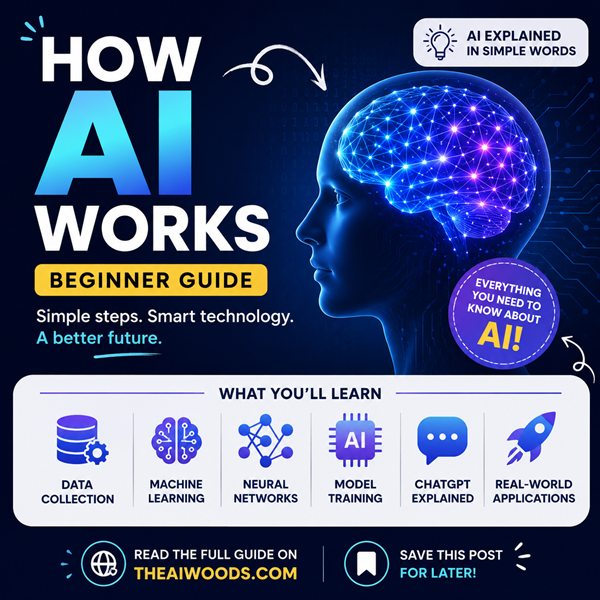
Futuristic Artificial Intelligence :
Futuristic Artificial Intelligence illustration with neural networks, glowing AI brain, machine learning workflow, robotics, cloud computing, blue digital technology background, infographic style
🧠 What is AI?
Artificial Intelligence (AI) is technology that allows machines to:
- Learn from data
- Understand language
- Recognize images
- Make predictions
- Automate tasks
AI systems improve over time using data and training.
⚙️ How AI Works
AI works in a step-by-step process.
| Step | Process | Description |
|---|---|---|
| 1 | Data Collection | AI gathers information |
| 2 | Data Processing | Data is cleaned and organized |
| 3 | Training | AI learns patterns |
| 4 | Prediction | AI gives answers/results |
| 5 | Improvement | AI improves with feedback |
📊 Data Collection
AI needs large amounts of data.
Examples
| AI Tool | Data Used |
|---|---|
| ChatGPT | Text and articles |
| YouTube AI | Watch history |
| Self-Driving Cars | Camera and sensor data |
| Face Recognition | Images and videos |
Better data helps AI perform better.
🧬 Machine Learning Explained
Machine Learning helps AI learn from data.
AI Learning Process
- AI studies data
- Finds patterns
- Makes predictions
- Corrects mistakes
- Improves accuracy
This process repeats millions of times.
🔗 Neural Networks
Neural networks are inspired by the human brain.
They help AI understand:
- Images
- Speech
- Text
- Patterns
Simple AI Flow
Input → Processing → Output
Example:
Photo → AI analyzes image → “This is a dog.”
Futuristic neural network :
Futuristic neural network with glowing connected nodes, deep learning visualization, AI brain concept, blue digital background
💬 How ChatGPT Works
ChatGPT uses:
- Deep Learning
- Large Language Models (LLMs)
- Transformer AI technology
It predicts the next word based on patterns learned from massive text data.
Example:
“AI is transforming…”
→ “…the future of technology.”
🚀 Types of AI
| AI Type | Example |
|---|---|
| Narrow AI | Chatbots, recommendations |
| Generative AI | ChatGPT, AI image tools |
| General AI | Future human-like AI |
🌍 Real-World AI Uses
| Industry | AI Usage |
|---|---|
| Healthcare | Disease detection |
| Banking | Fraud detection |
| Education | Personalized learning |
| E-Commerce | Product recommendations |
| Cybersecurity | Threat detection |
| Marketing | Customer targeting |
✅ Benefits of AI
AI helps businesses and users by:
- Saving time
- Improving accuracy
- Automating work
- Enhancing customer experience
- Providing smart insights
⚠️ Challenges of AI
| Challenge | Description |
|---|---|
| Bias | Poor training data |
| Privacy | Large data usage |
| Security Risks | Potential misuse |
| Job Changes | Automation impacts jobs |
Responsible AI development is important.
🔮 Future of AI
AI will continue growing in:
- Robotics
- AI coding assistants
- Automation
- Healthcare
- Business analytics
- Personalized AI systems
AI is expected to transform nearly every industry.
📌 Final Thoughts
Artificial Intelligence works using:
- Data
- Machine Learning
- Neural Networks
- Continuous Training
The more data AI receives, the smarter it becomes.
Understanding AI is becoming an important digital skill.
❓ FAQs
What is AI?
AI is technology that helps machines learn and make decisions.
Is ChatGPT an AI?
Yes. ChatGPT is an AI language model powered by deep learning.
What is Machine Learning?
Machine Learning allows AI systems to learn from data.