

🤖 Introduction
Artificial Intelligence has achieved remarkable success in recent years. From generating content and writing code to diagnosing diseases and driving cars, AI is transforming industries worldwide.
But there’s one question that continues to challenge even the most advanced AI systems:
Can AI handle something it has never seen before?
The answer lies in understanding a concept known as “Unknown Unknowns”—the unexpected events, situations, and challenges that no dataset, algorithm, or prediction model can fully anticipate.
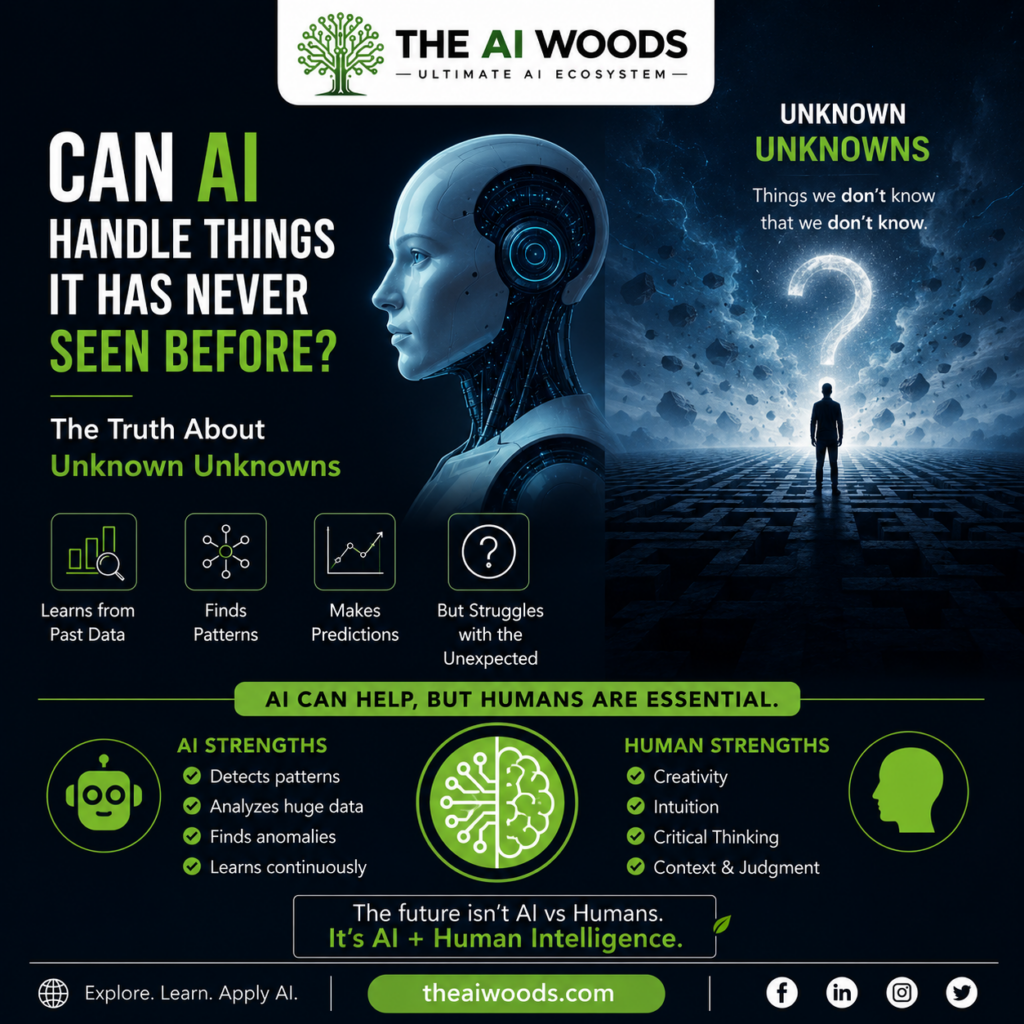
🧩 What Are Unknown Unknowns?
Unknown unknowns are:
Things we don’t know that we don’t know.
Unlike known problems that can be studied and predicted, unknown unknowns emerge unexpectedly and often reshape entire industries.
Examples:
🌍 Global pandemics
💥 Sudden economic crises
🔬 Unexpected scientific discoveries
⚡ Revolutionary technologies
🌪 Natural disasters beyond historical patterns
📈 Market disruptions no analyst predicted
These events often have little or no historical precedent, making them extremely difficult for AI systems to anticipate.
🧠 How AI Usually Learns
AI models learn by identifying patterns from data.
AI excels at:
📊 Pattern recognition
🔍 Image and speech analysis
📈 Predictive analytics
💬 Language generation
⚙ Process automation
🧮 Complex calculations
The more relevant data AI has seen, the better it generally performs.
However, unknown unknowns present a different challenge.
🚧 Why Unknown Unknowns Are Difficult for AI
AI fundamentally relies on past information.
When confronted with something entirely new:
❌ No historical examples exist
❌ Patterns may not apply
❌ Predictions become unreliable
❌ Confidence can be misleading
❌ Training data may be irrelevant
Imagine teaching someone to recognize cats and dogs, then suddenly showing them an entirely new species they’ve never encountered.
They might guess—but they won’t truly understand what they’re seeing.
AI faces a similar problem.
🔍 How Modern AI Attempts to Handle Unknown Unknowns
Although AI cannot perfectly predict the unexpected, researchers have developed techniques to improve resilience.
🎯 1. Uncertainty Estimation
Advanced AI systems estimate confidence levels.
Instead of saying:
“I am 100% certain.”
The AI may respond:
“I am only 55% confident in this prediction.”
This helps identify situations requiring human review.
🚨 2. Anomaly Detection
AI can identify unusual behavior that differs from normal patterns.
Examples:
🏦 Fraud detection
🌐 Cybersecurity threats
🏭 Equipment failures
🏥 Medical abnormalities
While AI may not know exactly what happened, it can flag something as suspicious.
🔄 3. Continuous Learning
Some AI systems continuously update based on new information.
Benefits include:
✅ Adapting to changing environments
✅ Learning from recent events
✅ Improving over time
✅ Reducing outdated assumptions
However, even continuous learning cannot predict events that have never occurred.
👥 4. Human-in-the-Loop AI
Many organizations combine AI with human expertise.
AI contributes:
⚡ Speed
📊 Data analysis
🔍 Pattern detection
Humans contribute:
🎨 Creativity
🧠 Common sense
⚖ Judgment
🌍 Context awareness
🤝 Ethical decision-making
This partnership often produces the most reliable outcomes.
🌍 Real-World Examples
📉 Financial Markets
AI can analyze millions of market signals.
Yet major events such as:
💥 Geopolitical conflicts
🏦 Banking crises
📜 Regulatory shocks
can trigger behaviors outside historical patterns.
Human decision-makers remain critical.
🏥 Healthcare
AI assists doctors in identifying diseases.
However:
🦠 New diseases
🧬 Rare conditions
⚕ Unusual symptoms
may require medical expertise beyond existing datasets.
🚗 Autonomous Vehicles
Self-driving systems perform well in expected conditions.
Challenges arise when encountering:
🚧 Unusual road layouts
🐘 Unexpected obstacles
🌪 Extreme weather
🚑 Rare emergency situations
These represent real-world unknown unknowns.
🔮 Will AI Ever Master Unknown Unknowns?
The short answer:
Probably not completely.
AI will become better at:
✅ Detecting uncertainty
✅ Recognizing anomalies
✅ Adapting faster
✅ Learning from new data
But true unknown unknowns are, by definition, impossible to fully predict.
This is where human intelligence continues to provide unique value.
🌟 The Future: Human + AI Collaboration
The most successful future won’t be AI replacing humans.
Instead, it will be:
🤖 AI + 🧠 Human Intelligence
AI handles:
⚡ Scale
⚡ Speed
⚡ Data processing
Humans handle:
💡 Innovation
🎯 Strategic thinking
🌍 Adaptability
🤝 Leadership
Together, they create stronger and more resilient systems than either could alone.
🎯 Key Takeaway
AI learns from the past. Unknown unknowns emerge from the future.
While AI can help detect risks, identify anomalies, and adapt to new information, the ability to navigate truly unprecedented situations remains one of humanity’s greatest strengths.
As AI continues to evolve, the winners will not be those who compete with AI—but those who learn how to work alongside it.
🌳 About The AI Woods
At The AI Woods, we help students, professionals, creators, and businesses understand the rapidly evolving world of Artificial Intelligence through practical insights, AI tools, learning resources, workshops, and community-driven knowledge.
Explore More AI Insights 💰
Visit The AI Woods for:
Learn. Build. Grow with AI. 🚀
⚠️Disclaimer
This article is intended for educational and informational purposes only. AI technologies and market trends change rapidly, and career outcomes vary depending on individual skills, industries, and economic conditions.
The AI Woods does not guarantee specific employment or business output etc.