

Artificial Intelligence is no longer replacing individual tasks—it is collaborating with humans to complete complex work. As AI agents become more autonomous, a new responsibility has emerged:
🤖 What is Botsitting?
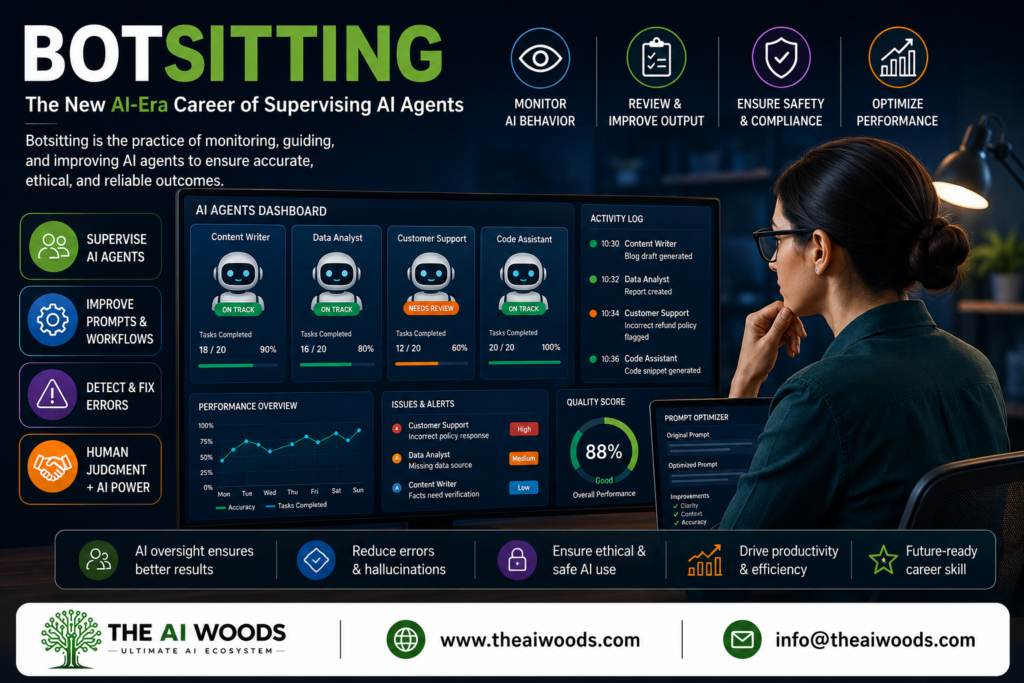
Botsitting is the practice of supervising, monitoring, guiding, and improving AI assistants or autonomous AI agents while they perform tasks.
Just as a babysitter watches over children, a Botsitter watches over AI systems to ensure they:
✅ Produce accurate outputs
✅ Follow company policies
✅ Stay within ethical boundaries
✅ Avoid hallucinations
✅ Complete assigned tasks correctly
✅ Escalate problems when necessary
Instead of doing every task manually, professionals increasingly spend time managing AI teammates.
💡 Simple Example
Imagine an AI agent that:
📧 Replies to customer emails
📅 Schedules meetings
📊 Creates weekly reports
💻 Writes code
A Botsitter:
👀 Reviews responses
🛠️ Corrects mistakes
🎯 Fine-tunes prompts
📈 Monitors performance
⚠️ Stops incorrect actions before they cause issues
🌍 Why Botsitting is Growing
The rise of:
🤖 AI Agents
🧠 Large Language Models (LLMs)
⚙️ Workflow Automation
🏢 Enterprise AI
💬 AI Customer Support
📊 AI Analytics
has created the need for human oversight.
Companies cannot simply deploy AI and leave it unsupervised.
Someone must ensure the AI works reliably.
🎯 Key Responsibilities of a Botsitter
- 👀 Monitor AI behavior
- 📝 Review AI-generated content
- 🎯 Improve prompts and instructions
- ⚠️ Detect hallucinations and errors
- 🔒 Ensure privacy and security compliance
- 📈 Track AI performance metrics
- 🤝 Coordinate multiple AI agents
- 🔄 Continuously optimize AI workflows
- 📚 Train teams on AI best practices
- 🧩 Escalate complex decisions to humans
🛠️ Skills Required
✅ Prompt Engineering
✅ Critical Thinking
✅ AI Tools Knowledge
✅ Communication
✅ Quality Assurance (QA)
✅ Data Validation
✅ Workflow Automation
✅ Problem Solving
✅ Business Understanding
✅ Ethics & Responsible AI
💼 Industries Hiring Botsitters
🏦 Banking
🏥 Healthcare
🛍️ E-commerce
📞 Customer Support
💻 IT Services
📈 Marketing
⚖️ Legal
🎓 Education
🚚 Logistics
🏢 Enterprise Software
💰 Career Opportunities
As AI adoption accelerates, Botsitting skills can lead to roles such as:
- 🤖 AI Operations Specialist
- 🧠 AI Agent Manager
- 📊 AI Workflow Analyst
- 🛡️ AI Quality Assurance Specialist
- 💬 Conversational AI Manager
- ⚙️ Automation Specialist
- 📈 AI Product Operations Manager
- 👨💼 AI Program Manager
🚀 How to Become a Botsitter
1️⃣ Learn Generative AI fundamentals
2️⃣ Practice Prompt Engineering
3️⃣ Use AI tools daily
4️⃣ Understand AI limitations
5️⃣ Learn workflow automation platforms
6️⃣ Build AI projects
7️⃣ Study Responsible AI principles
8️⃣ Stay updated with emerging AI trends
⭐ Why Botsitting Matters
As organizations deploy more AI agents, human oversight becomes even more valuable. Botsitting isn’t about competing with AI—it’s about ensuring AI systems are accurate, trustworthy, secure, and aligned with business goals.
Professionals who can effectively supervise AI are likely to become increasingly important across many industries.
📌 Key Takeaways
✔️ Botsitting means supervising AI agents.
✔️ It focuses on monitoring, improving, and governing AI systems.
✔️ Demand is expected to grow as AI becomes part of everyday business operations.
✔️ Combining AI literacy with human judgment is a valuable career advantage.
✔️ Learning Botsitting today can help prepare you for AI-enabled workplaces.
🌐 The AI Woods
Ultimate AI Ecosystem
🚀 Learn • Build • Grow with AI
Explore More AI Insights 💰
Visit The AI Woods for:
⚠️ Disclaimer
This article is intended for educational and informational purposes only. AI technologies and market trends change rapidly, and career outcomes vary depending on individual skills, industries, and economic conditions.
The AI Woods does not guarantee specific employment or business output etc.